
One-time license · full source code · runs locally on your own machine
Measured 2026-10-26 · every number on this site, with the query that produced it

You opened your laptop at 9 p.m. “just to send a few applications.” By midnight you'd scrolled past 200 listings. Half were reposts. A third wanted “5 years of experience” for an entry-level title. You found six that looked right, rewrote your summary six times, re-typed your work history into six different forms that couldn't read the résumé you'd just uploaded.
And then you waited. Nothing came back. Not a rejection. Not an auto-reply. Nothing.
A single corporate posting can draw hundreds of applicants, and in a lot of hiring now they're screened by software before a human ever looks. The people getting interviews aren't always the most qualified. They're the ones who apply early, apply often, and apply to the right roles.
That's a volume game. And no person with a job, kids, or a life can win a volume game by hand.
So you're stuck choosing between two bad options:
Most people pick the second option because it feels responsible. Then they burn out on it by week three.
Nobody tells you what a job search actually costs. So let's add it up.
It costs you time. If you spend 20-30 minutes per application, then fifty applications is roughly 17 to 25 hours. That's roughly half a work week, spent copying your own job titles into dropdown menus. If you already have a job, those hours come out of your evenings and weekends. If you don't, they come out of the time you should be spending preparing for interviews, networking, or simply staying sane.
It costs you money. Every week you're not in the right role is a week of income you don't get back. If you're unemployed, the math is brutal. If you're underpaid, it's quieter but just as real: every month you stay in the wrong job is a month at the wrong salary.
It costs you confidence. This is the one nobody talks about. Send forty applications and hear back from two, and something starts to whisper that maybe the problem is you. It isn't. But silence is loud, and after enough of it, you start applying to jobs beneath your experience just to hear anything back.
It costs you opportunities you'll never know you missed. The perfect role for you might have been posted on Tuesday morning. By the time you found it on Saturday, the hiring manager already had a shortlist. You didn't get rejected. You were simply too late to be considered.
Here's what's happening on the other side of that “Submit” button.
Employers are flooded. A single opening can pull in more applications than a recruiter could read in a week. So they lean on software to sort, filter and rank candidates, and on timing: the earliest strong applicants get the first look, and once the pipeline is full, the posting quietly stops mattering.
Meanwhile, the job boards themselves are noisy. Reposted listings. Roles that were filled weeks ago. Titles that don't match the actual job. Salary ranges that are missing or meaningless. You spend half your search just figuring out which listings are worth reading.
So the game has three rules, and none of them are “be the most qualified”:
A human can do one of those well. Maybe two, for a few weeks. Nobody can do all three, every day, for as long as a job search takes, and still have a life.
That's not a character flaw. It's a capacity problem. And capacity problems have a solution.
Meet NetaJob: your full-time job-search assistant that never clocks out. NetaJob does the tedious 90% of job hunting (finding, filtering, filling out) so you can spend your energy on the part that actually decides it: the interview.
We've all been the person at the kitchen table at midnight, tabbing between job boards and wondering why something this important has to be this tedious.
The frustrating part was never the work itself. Searching for a job should take effort: deciding what you want, preparing for interviews, negotiating an offer. That effort is worth it. What isn't worth it is the hundredth time typing your graduation year into a form, or scrolling past the same reposted listing for the fourth day in a row.
So we asked a simple question: what if the boring parts just happened on their own?
What if software could read every new listing the moment it appeared, decide honestly whether it fit you, and handle the paperwork for the ones that did, without you giving up your privacy to some company's cloud?
That last part mattered to us. The tools we looked at wanted you to upload everything: your résumé, your logins, your salary history, your entire search. We didn't think anyone should have to trade their personal data for a little convenience. So we built NetaJob to run entirely on your own computer, under your control, with nothing coming back to us.
The result is the assistant we wished we'd had: one that works quietly in the background, only goes after jobs that make sense, and leaves you free to focus on the part of the search that actually requires you.
Add your résumé and fill in your profile: your facts, target titles, salary floor, locations, remote preference and dealbreakers. NetaJob uses it as the single source of truth for every answer it gives, stored in your own database.
Every day it scans new postings across major job boards and gives each one a Fit Score from 0–10 based on your actual qualifications, not keyword guesswork. Below your threshold? Skipped. No more wasted applications.
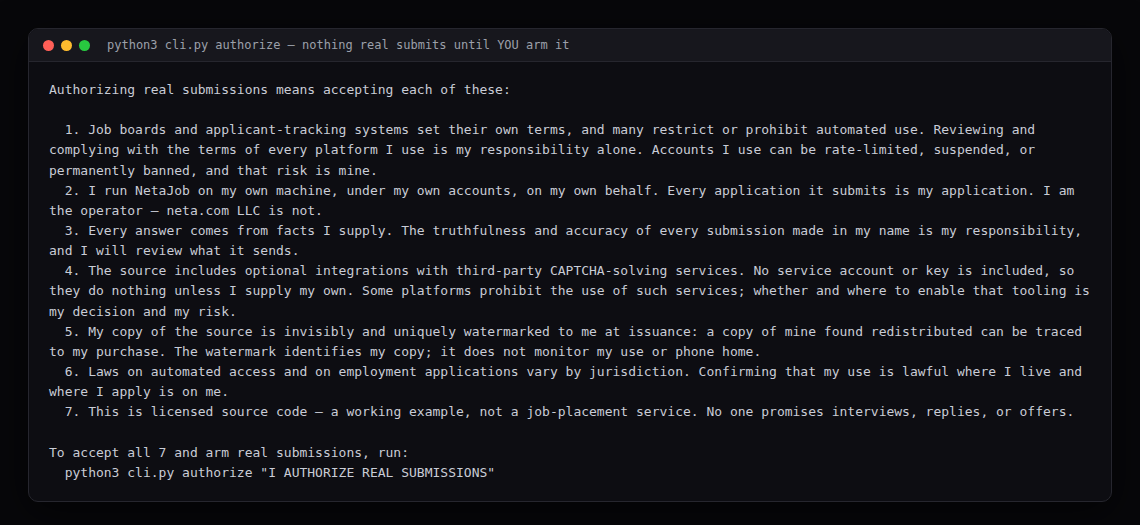
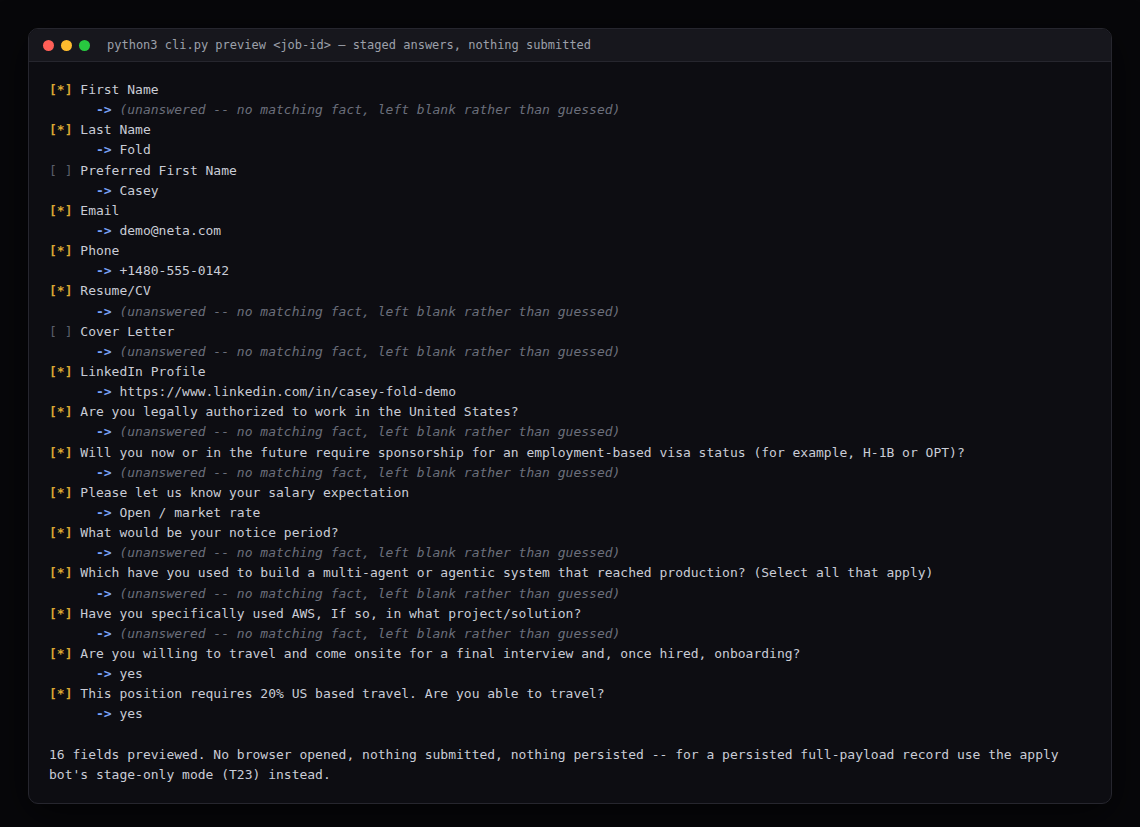
Every run stages the real form first — every field's label and value logged, screenshot taken — and stops before the final submit. Real submissions ship OFF. Once you turn them on, NetaJob submits strong matches at a steady, natural pace from your own computer and your own accounts.
Every application is logged to your own database: the job, its Fit Score, the résumé it sent, and a saved copy of the exact posting. It also sorts your inbox, so real replies from employers don't get buried under automatic confirmations.
You stay in control. Set your Fit Score threshold and choose which platforms it runs on. Use preview mode to see exactly what would be filled, and why, before any browser opens. Turn real submissions back off any time. Stop it anytime.
Not a developer? You don't need to be. NetaJob is source code, but running it comes down to a handful of simple commands. If you've never opened a terminal, an AI assistant like Claude can walk you through setup step by step: tell it what you want to do, and it tells you exactly what to type.
A lot of automation tools have one setting: more. More applications, more listings, more noise. That's how you end up applying to a night-shift warehouse role when you're a marketing manager.
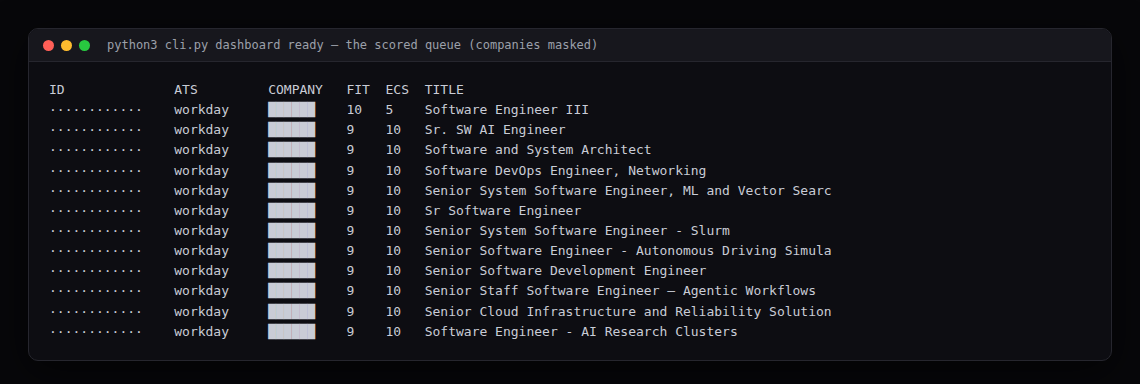
NetaJob works the other way around. Before it ever submits anything, it asks the question a good recruiter would ask: is this person actually a fit for this job?
To answer it, NetaJob compares each listing against the profile you built during setup:
Each job gets a Fit Score from 0 to 10. You decide where the bar sits. Set it high and NetaJob becomes a sniper, applying only to roles that line up almost perfectly. Set it lower and it casts a wider net. Either way, it never applies to a job you'd be embarrassed to get a call about.
And because you can see the score for every listing, you learn something too. Notice your scores keep dipping on one requirement? That's a signal about which skill to highlight, which certification to pursue, or which titles you should really be targeting.
This is a day after setup, once you've reviewed the staged forms and turned real submissions on yourself.
7:00 A.M.
While you're making coffee, NetaJob has already scanned the listings posted overnight.
It's scored them, skipped the ones that don't fit, and queued up the strong matches.
7:15 A.M.
You glance at the log. A few new applications went out overnight, each one scored above
your threshold. There's nothing for you to do.
9:00 A.M. TO 5:00 P.M.
You go about your day. Your job, your kids, your errands, your life. NetaJob keeps
watching for new postings and works through them at a steady, natural pace.
6:30 P.M.
You check your inbox. Because NetaJob sorted it, the one real reply from an employer sits
right at the top instead of under a pile of automatic confirmations, and NetaJob hands you
the exact posting you applied to. Instead of spending tonight filling out forms, you spend
twenty minutes researching that company and preparing for the call.
10:30 P.M.
You go to bed at a reasonable hour for the first time in weeks. NetaJob keeps going.
That's the whole shift: from spending your energy on the applying to spending it on the interview.
| Applying By Hand | With NetaJob | |
|---|---|---|
| Applications Per Week | 5–10 | Hundreds |
| Time Spent | 5+ Hours | Minutes, Reviewing |
| Speed To New Postings | Days Or Weeks | Same Day |
“Hundreds” is measured, not projected: the operator's own run peaked at 761 applications in one week (week of 2026-08-17), against 10,600+ submitted across every version of this pipeline — counted as this release's 5,400+ submission events plus the 5,200+ applications in the frozen import of every earlier version's history, two separate instruments added together, measured 2026-10-26 (queries here). Your own numbers depend on your Fit Score threshold, which platforms you enable, and how long you leave it running. The by-hand column is the pace a motivated person actually sustains, not a worst case.
If you want to see the shape of that data before you buy anything, it is published: what the forms actually ask, and what came back — counts with the query that produced each one, and no employer named.
NetaJob — $189, one time
Full source code, watermarked to you, delivered by signed download link. No subscription, ever.
See the full offer ↓A job tool that runs in the cloud holds your résumé, logins and salary expectations on its servers. NetaJob doesn't. It's software you download and run on your own machine. We never receive your résumé, your credentials, or the jobs you apply to. Not because we promise not to look, but because it never leaves your computer in the first place.
That matters if you're job hunting while employed. Nobody needs to know but you.
Think about what a job search actually reveals about you. Your full work history. Your current employer. The salary you'd accept. The companies you're quietly talking to. The fact that you're looking at all.
That's some of the most sensitive information you have — and handing it to any cloud service means trusting their security, their terms, and whoever owns them next.
With NetaJob, there's nothing to trust, because there's nothing to hand over.
You buy a license, you download it, you run it. What happens on your computer stays on your computer.
This page itself keeps basic analytics (which page, which referrer, which country) and a first-party ID in your browser — no third-party ad trackers, and we don't store your IP address. Details in the privacy policy.
We'd rather be honest than make a sale that doesn't help you.
Free in dollars, expensive in everything else. You control every detail, but you're limited by your own hours and energy. For most people, that means applying to far fewer jobs than they need to, and too late.
Valuable for strategy, interview practice and confidence, but coaches typically charge by the hour, and they don't fill out applications for you. A few sessions can cost more than NetaJob does outright.
Great when it works, but recruiters work for the employer, not for you. They'll call when you fit a role they're trying to fill, and you'll wait when you don't.
They can save time, but because they run in the cloud they need your résumé, credentials and job search on their servers, and are often a recurring subscription for as long as you're searching.
NetaJob. A one-time purchase. Runs on your own computer. Scores every job for fit before applying. Works every day without you. And keeps your data where it belongs: with you.
After setup, the assistant is the interface: open the desktop icon and tell it what you want in plain English — "set up my profile", "find me jobs", "why did this application fail?" The command line is still there when you want it, but it's never the price of entry.
The license is the only thing we ever charge for. Scoring costs whatever your model provider charges — we don't sit in the middle of it, so instead of quoting you a price that belongs to someone else, here are the measured inputs to price it yourself. Read from the code and the operator's own run: each job scored is one AI call of roughly 3,000 tokens in and a few hundred out (job descriptions are capped at 4,000 characters by the code, so a call is bounded by design, not by hope), at a realistic pace of about 100 scored jobs a day. Price that against your provider's current rate card — or skip the question entirely:
These are the operator's own figures; your actual cost and throughput will vary with your context — your hardware, the model you choose, and how many jobs you run. Cloud prices and free-tier allowances belong to the providers and change without notice, which is exactly why no dollar figure for them is printed here; your exact allowance shows in your own provider account. There is nothing metered from us to mark up.
This is the differentiator, so here it is plainly:
For a handful of applications, your laptop is fine. Once you're harvesting and applying at real volume, put the bots on their own machine instead — a spare computer, a home server, or a cheap cloud VPS. That keeps browser-automation traffic separate from your everyday browsing, so a bot session that gets challenged or blocked by a site never touches the accounts and cookies you use day to day, and vice versa. This machine isn't included with the license — bring your own, the same way you bring your own database and your own accounts.
Nothing exotic is required to run it: any Linux, macOS, or Windows box with Python 3, Firefox, and geckodriver installed, plus a stable internet connection. No GPU is needed unless you're also running local-LLM scoring on the same machine.
Nothing here is oversold. Four things worth knowing going in:
No. NetaJob only applies where your real experience is a strong fit, and every run stages the form so you can review it before anything goes.
Only if you tell it to. You set the titles, salary floor, locations and minimum Fit Score. Anything below the bar is skipped.
It runs on your computer and nothing is sent to us. We couldn't see your résumé if we wanted to. Credentials live only on your machine, in an encrypted store with the key held outside the database — never in a plain file.
No. NetaJob only uses facts from your profile. When a form asks something it doesn't know, it flags the question for you instead of guessing. Legally significant fields — citizenship, sponsorship, clearance, criminal history — ship blank on purpose.
Applications on Greenhouse, Workday, Lever and Ashby, plus a tenant-parameterized Avature bot for Koch/Deloitte/TSMC-class career sites. LinkedIn is included too, with the account-risk caveat in the honest limits above — read its module notes first. Indeed postings that lead to one of those systems are picked up and handled the same way.
You're filling in your own applications, with your own facts, from your own machine and accounts — the same thing you'd do by hand, delegated to scripts you can read. Platforms set their own terms, and some watch the rhythm of applications; the package paces itself like a motivated person (per-company daily caps, bounded batches, human-hours gating) and never invents an answer to get a form through. The one exception worth reading about first is LinkedIn: its account risk sits in the login itself, and the module notes say so plainly before you run it.
It will. Applicant Tracking System platforms change their own sites without notice, so a technique verified today can break tomorrow — on their end, not the code's. The answer you're buying is that the code is plain, readable Python: your own coding agent can fix or extend it, the package ships a worked guide for adding a new platform, and eight worked examples of how the same category of problem was already solved. And to be plain about the other side of it: no guarantee of employment outcome, ever.
No. NetaJob is a one-time purchase. Pay once, download it, and use it. No monthly fees, ever.
Not very. NetaJob is source code you run on your own machine with a few simple commands. If you've never used a terminal, ask an AI assistant like Claude to walk you through it; it'll tell you exactly what to type. You'll bring your own job board accounts, your own database and your own secrets store, and the assistant can help you set those up too.
NetaJob works while it's running on your machine. Many people leave it going during the day or overnight. When it isn't running, nothing is sent; start it again whenever you're ready.
Yes. Real submissions are off until you turn them on. You set the Fit Score threshold and choose which platforms it runs on. Preview mode shows you exactly what would be filled before any browser opens (Greenhouse today). You can stop NetaJob at any time, for an hour or for a month.
NetaJob runs privately on your own computer, and we never receive your search data. As with any job search, use your judgment about which companies you apply to, and consider running it on a personal computer rather than a work device.
Congratulations. Pause NetaJob or close it. Because it's a one-time purchase, your license is still good if you ever need it again, whether that's next year or five years from now.
Yes, and the Fit Score is especially useful here. It shows you which roles your existing experience actually supports, so you can target realistic stepping-stone positions instead of guessing.
Yes. Set your location preference to remote and NetaJob will skip on-site and hybrid listings.
That's your call to make, and we won't pretend to make it for you. What we can tell you is what it is: a one-time $189 for the full source of a system that has submitted 10,600+ real applications across its versions (measured 2026-10-26), with no subscription behind it and no outcome anyone can promise you. Weigh that against what your evenings are worth and what a career coach charges for an hour.
Everything above ships in the license. There are no separate add-ons to buy.
Career coaching typically runs well over $100 an hour. A month of manual applying costs you 20+ hours. NetaJob is a one-time purchase of $189. No subscription, no monthly fees. Pay once, download it, and the license is yours.
Let's put that in perspective.
Now look at the other side of the ledger. If NetaJob saves you even ten hours a week, and most job searches last for months, you're getting back well over a hundred hours of your life. What's an hour of your evening worth? Your weekend? Your peace of mind?
There's no subscription to forget about, no monthly bill while you're between paychecks, and no price increase next year. One payment. A license that doesn't expire.
This is licensed software, not sold outright — ownership stays with neta.com LLC, a
Wyoming limited liability company. Each copy you receive is uniquely, invisibly
fingerprinted to you at issuance; the license prohibits redistribution, resale,
sublicensing, or stripping that fingerprint, and treats its presence in an unauthorized
copy as evidence of where that copy came from. Full terms ship in LICENSE.md
with the package. This page is a summary, not the agreement.
Every day you wait, new postings fill with applicants who got there first. Job searches have a way of stretching out. One more week of “I'll get to it this weekend.” One more month of telling yourself the market will pick up. Meanwhile, the roles you'd be perfect for are being posted, filled and closed without you ever seeing them.
The longer a search drags on, the harder it gets: the gap on your résumé grows, savings shrink, and motivation fades. Momentum matters, and momentum is exactly what NetaJob gives you. From the first day it runs, you're in the game every single day, not just on the days you have the energy.
You don't need a new résumé, a new strategy or a new burst of willpower. You need consistency. NetaJob is consistency you can download.
You can't read every job out there, so let this score them for you. You don't want “we got your application” burying the one email that matters, so let this sort your inbox. You don't want to fill out the same form fields by hand a thousand times, so let scripts do that part. And when an interview finally happens, it hands you back the exact posting you applied to, instead of you trying to remember it. That's the whole pitch.
| A working AI automation system, yours | The whole working example: LLM scoring, a two-tier local+cloud inference stack, structured-output prompting, and a self-improving answer loop — full readable source. Run it, read it, feed it to your bot, change it. |
|---|---|
| The skills teams are hiring for | Local-plus-cloud LLM routing, scoring pipelines, browser automation driven by model output — learned from code that actually ran, not a tutorial. |
| A job search that runs itself | 10,600+ real applications have gone through it — proof it actually runs, not a demo. Out of work and have the time? Run it as wide as you like — every posting fit-scored and staged for your review, never spray-and-pray. |
| You own it — $189, once | Not per month, not per seat, no API to rent. The license is the only thing we ever charge for, and it's yours to keep. |
| Runs on your machine | Readable Python. No account, no server, nobody holding your résumé hostage. Your copy watermarked to you. |
NetaJob is a working example of a real AI job-application system — the complete, running code, not a course or a demo. Read it yourself, or hand it to your own AI assistant: a working example is what you and your bot build on fastest, and this one has actually run.
It reads new postings every day; a language model scores each one against your real background, fills the forms from your own facts, and leaves them staged for you to review. You approve. It submits. Under the hood it runs a two-tier inference stack — a local model (Ollama / Qwen) does the volume, a cloud model handles the hard calls — plus a scoring pipeline and an answer loop that learns the questions it has not seen before.
So the $189 buys two things at once: a job search that runs while you don't, and a real AI-automation system you learn by owning. Source is the training.
This is why it's licensed source and not a service: you run it, on your machine, under your own accounts. You're the operator — in full control of what it does and when, and nothing we host sits between you and your search. You own the system and everything you learn pulling it apart.
10,600+ real applications have gone through it, over about 5 months.
It runs on your computer. Your résumé, your logins and your search never touch our servers. Plain, readable Python you own — and nothing submits for real until you turn that on yourself.
What you study by owning it: LLM scoring of a job description against a résumé; structured-output prompting; a two-tier local-then-cloud inference architecture that keeps cost down; a self-improving answer system that logs what it can't answer and learns it; and browser automation driven by model output. The patterns employers are hiring for — in a codebase that actually ran, not a tutorial. “I ran, read, and modified a two-tier LLM automation system over my own search” is a very different sentence from “I used a bot” — and reading the code, not just running it, is what makes the first one true for you.
It does not get you hired. Nobody can sell you that, and anybody who implies it is selling you something else.
It fails. Sometimes it hits a question it has never seen. When that happens it stops and logs the question instead of inventing an answer — because a made-up answer on a real application is worse than no application. Each logged miss is a one-time fix you make once and never again.
It says no far more than it says yes. Far more postings were screened out than ever applied to. The filtering is most of what you're buying.
Every number on this page carries the query that produced it. Run them yourself: neta.com/stats
Postings get filled from the top of the pile, and the pile is sorted by when you applied. Every evening you spend typing is a day of applications you didn't send.
Own the same system that's been running live, every day, in real production — not a demo built to impress you once. NetaJob — the client-side Applicant Tracking System (Source Edition).
$189, one time. Full source code, watermarked to you, delivered by signed download link to the email on your receipt. Delivery is automated; if it hasn't arrived, reply to the receipt and it will be sent by hand.
Payment handled by Stripe Checkout — your card details never touch our servers.
Not ready? Leave your email instead and you'll hear from us once, when there's something worth saying. No drip sequence, no countdown timer.
One email when there's something worth saying. No list rental, no reselling your address, unsubscribe any time. We keep basic analytics (which page, which referrer, which country) and a first-party ID in your browser so we can tell repeat visits apart — no third-party ad trackers, and we don't store your IP address.